Tension Decay Patterns in Archery Bowstrings Across Multi-Hour Practice Blocks Paired with Shooter Consistency Journals
Iris Lange · Jun 22, 2026
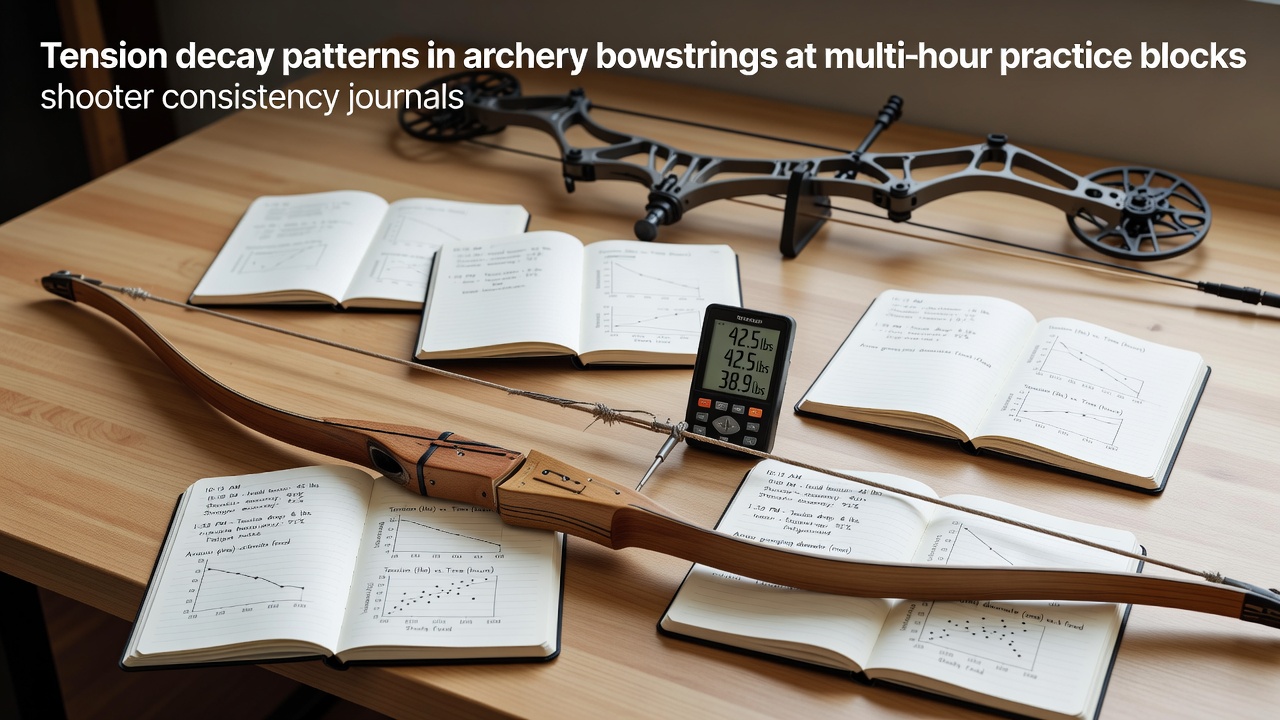
Tension Decay Patterns in Archery Bowstrings Across Multi-Hour Practice Blocks Paired with Shooter Consistency Journals
Archery bowstrings experience measurable tension reduction when subjected to repeated loading over sessions that stretch beyond three hours, and researchers track these shifts through controlled laboratory protocols alongside detailed shooter records. Materials like Dacron and Fast Flight show distinct elongation rates under cyclic stress, while data from force sensors reveal progressive drops that correlate with changes in arrow velocity and grouping patterns.
Observers note that tension loss accelerates during the first ninety minutes of continuous shooting before settling into a more gradual decline, and this pattern holds across different draw weights and environmental conditions. Those who've compiled multi-hour practice blocks report that initial tension readings often start at manufacturer specifications yet fall by two to four percent within the opening block, with further reductions accumulating as humidity and temperature fluctuate.
Measurement Approaches in Extended Sessions
Equipment monitoring combines digital tension gauges with high-speed cameras that capture string oscillation at each release, and studies pair these readings directly with shooter consistency journals that log arrow impact coordinates over time. The approach allows researchers to isolate material fatigue from shooter variables such as grip pressure or anchor point drift, while calibration checks occur at thirty-minute intervals to maintain data integrity.
One research team at a Canadian sports institute documented that bowstrings lose elasticity at different rates depending on the number of arrows released per hour, and their records indicate a plateau effect after approximately two hundred shots when ambient conditions remain stable. Shooters who maintained journals during these tests noted corresponding increases in horizontal spread once tension dropped below a critical threshold, providing a practical cross-reference for equipment maintenance schedules.
Correlation with Shooter Performance Records
Consistency journals reveal that groups tighten or widen in tandem with documented string tension values, and analysts cross-reference timestamped entries against sensor outputs to identify when decay begins to affect accuracy metrics. Participants in these studies typically record draw length variations, perceived vibration, and weather notes alongside each end of arrows, which creates a layered dataset that links equipment state to human output.
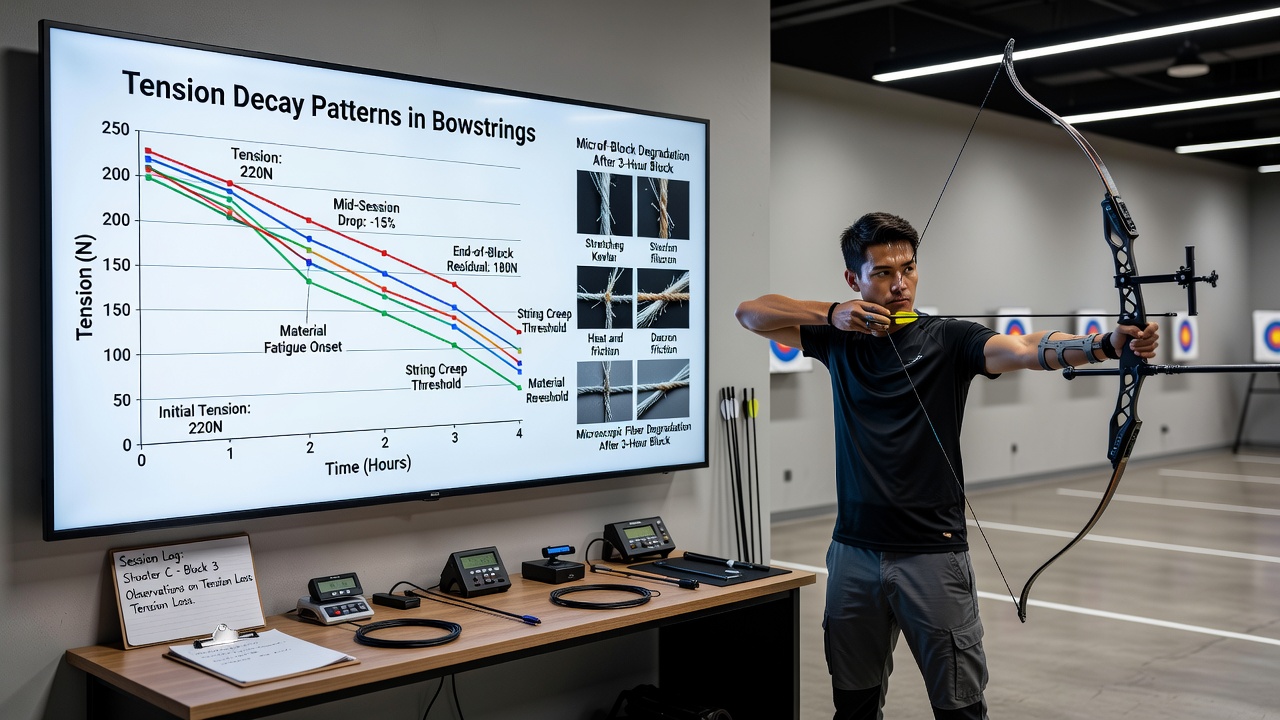
Figures from extended practice blocks show that a three-percent tension reduction often coincides with a measurable increase in vertical dispersion on target faces, and this relationship appears consistent whether shooters use recurve or compound equipment. Researchers at the Australian Institute of Sport have contributed comparative data from similar protocols, highlighting how regional climate differences influence the rate at which synthetic fibers relax under load.
Material Fatigue and Environmental Factors
Bowstring construction influences decay speed, since braided spectra fibers resist stretch better than older polyester blends during prolonged use, and field observations confirm that wax application intervals affect surface friction yet do not fully prevent elongation. Temperature swings above twenty-five degrees Celsius tend to hasten relaxation in certain polymers, while cooler conditions slow the process without eliminating it entirely.
Those compiling long-term journals frequently note that strings replaced at six-month marks maintain more stable performance curves than those left in service for a full year, and equipment logs from competitive circuits support this observation with velocity chronograph readings taken at the start and end of training days. The interplay between material properties and usage volume becomes evident when multiple shooters share the same bow over successive multi-hour blocks, as cumulative wear compounds faster than single-user patterns.
Data Integration Across Training Cycles
Analysis of paired datasets demonstrates that tension decay follows a nonlinear trajectory within each practice block, and mathematical models fitted to sensor outputs predict when shooters should pause for equipment inspection. Journals that include subjective notes on string feel complement quantitative measurements by flagging early signs of creep before instruments register significant change.
International governing bodies such as World Archery have referenced similar monitoring techniques in equipment standards discussions, while academic papers from European biomechanics laboratories examine how string tension interacts with limb geometry over repeated cycles. These sources supply baseline values that training programs use to establish replacement thresholds tailored to individual shooting volumes.
Conclusion
Archery programs that combine laboratory tension profiling with shooter-maintained consistency journals gain actionable insights into when bowstrings require adjustment or replacement, and the resulting records support more precise scheduling of maintenance during high-volume training periods. Continued collection of such paired data across different equipment types and climates refines predictive models that help maintain performance stability throughout extended sessions.