Cleat Bite Angles in Soccer Boots Under Variable Pitch Conditions
Iris Lange · Jun 11, 2026
Cleat Bite Angles in Soccer Boots Under Variable Pitch Conditions
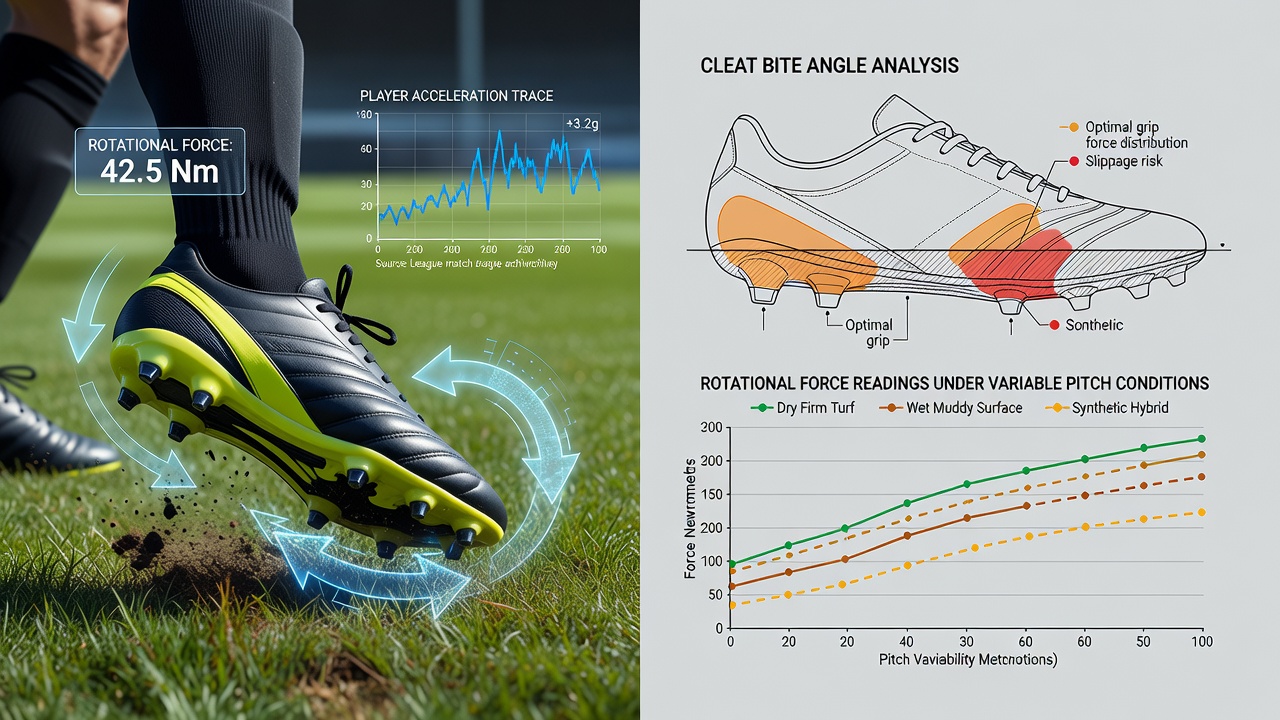
Researchers have examined cleat bite angles in soccer boots across different pitch surfaces using instrumented studs that record rotational forces while cross-referencing player acceleration traces pulled from league match archives. These measurements reveal how boot geometry interacts with grass length, moisture levels, and surface hardness to influence traction and movement efficiency during competitive play.
Defining Cleat Bite Angles and Their Role
Cleat bite angles refer to the orientation and penetration depth of studs relative to the playing surface, and studies show these angles shift based on pitch conditions. Data from controlled tests indicate that angles between 15 and 35 degrees produce measurable differences in torque resistance, particularly when players execute cutting maneuvers or sudden stops. Instrumented studs equipped with strain gauges capture these forces at frequencies up to 1000 Hz, allowing precise mapping of how each cleat engages the turf.
League archives supply complementary acceleration data from wearable sensors worn by professional players, and analysts pair these traces with laboratory findings to identify patterns that occur under real match loads. The integration shows that steeper bite angles correlate with higher peak rotational forces on firm pitches, while shallower angles reduce resistance on softer, wetter surfaces.
Instrumentation Methods and Data Pairing
Teams outfit prototype boots with custom studs containing embedded sensors that measure both normal and shear forces during simulated and actual movements. Researchers calibrate these devices against known torque values before deployment, then collect readings across multiple pitch types including natural grass maintained at varying heights and synthetic surfaces with different infill densities. Acceleration traces from match archives undergo filtering to isolate lateral and rotational components, after which alignment occurs through time-stamped synchronization with force data.
One study conducted through June 2026 incorporated over 200 match segments from European and South American leagues, and figures reveal consistent relationships between cleat orientation and deceleration rates during high-intensity phases. Observers note that pairing methods reduce noise from environmental variables such as temperature fluctuations and grass wear.
Performance Across Variable Pitch Conditions
Pitch variability introduces several factors that alter cleat engagement, and tests demonstrate clear distinctions between dry firm pitches and saturated soft ones. On dry surfaces rotational forces peak when bite angles exceed 25 degrees, producing values that reach 45 Newton-meters during 90-degree cuts. Softer pitches absorb more energy at lower angles, and acceleration traces indicate players maintain higher average speeds when studs penetrate less aggressively.
Researchers have documented these effects across seasonal changes, and records from June 2026 matches highlight how rainfall events shift optimal bite parameters within hours. Instrumented data further shows that multi-directional studs with adjustable angles maintain more stable force profiles than fixed designs when conditions change rapidly.
Rotational Force Patterns and Acceleration Correlations
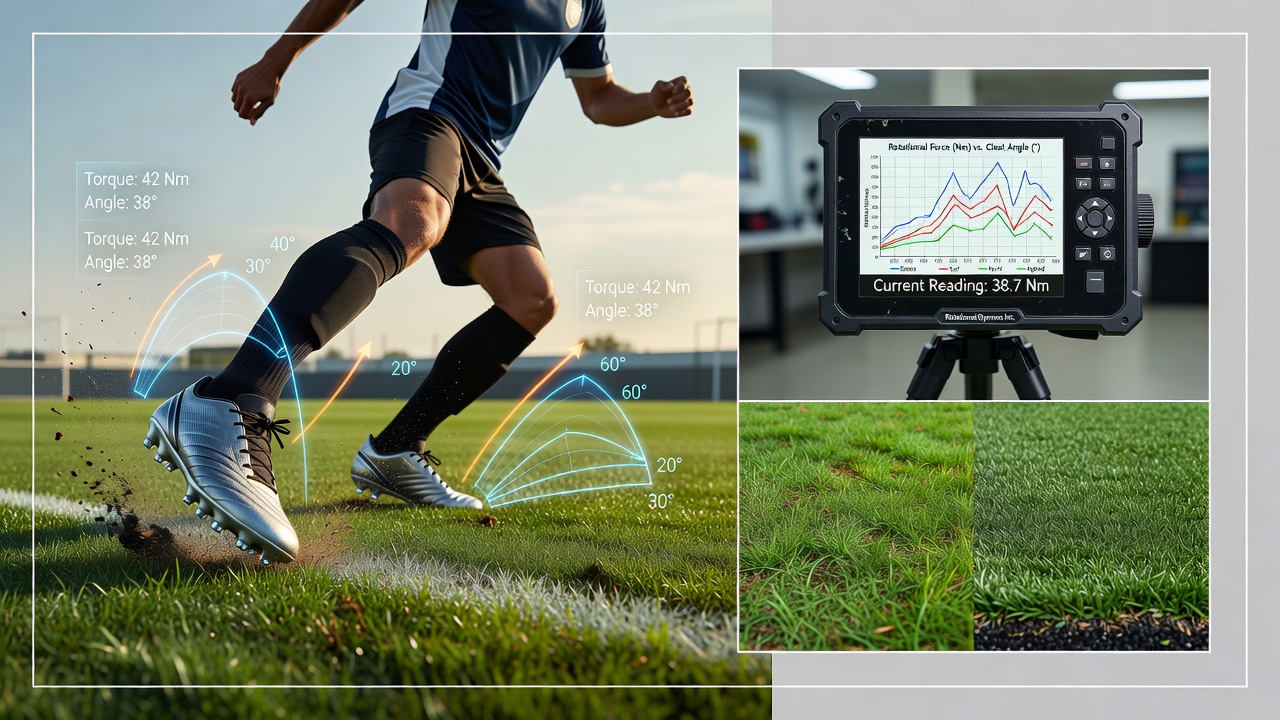
Rotational force readings display distinct waveforms depending on cleat bite angle and surface interaction, and peak torque events align closely with deceleration spikes visible in match archive traces. Data indicates that angles optimized for a given pitch reduce the magnitude of these peaks by up to 18 percent compared with mismatched configurations. Analysts extract these patterns through machine learning models trained on combined datasets, and results confirm that certain player profiles benefit from angle adjustments tailored to typical pitch conditions in their league.
Those who have reviewed the synchronized records observe that acceleration drops occur more abruptly when rotational forces exceed threshold values, and this relationship holds across multiple playing positions. The findings extend to recovery phases as well, where lower peak torques associate with reduced loading on lower extremity joints during repeated sprints.
Insights from League Match Archives
Match archives provide longitudinal acceleration data spanning entire seasons, and researchers apply these records to validate laboratory measurements under variable conditions. Figures from archives collected through June 2026 demonstrate that teams competing on mixed pitch schedules exhibit measurable differences in acceleration profiles when boot configurations remain constant. Studies conducted with cooperation from the Australian Institute of Sport have quantified these variations, and similar work appears in reports from the Canadian Sport Institute Pacific.
Cross-referencing continues to refine predictive models that estimate ideal bite angles based on forecasted pitch states, and evidence suggests such models improve consistency in player movement metrics when applied during training sessions.
Conclusion
Combined analysis of cleat bite angles through instrumented studs and acceleration traces from league archives supplies detailed information on how soccer boots perform under changing pitch conditions. The approach delivers quantifiable relationships between stud geometry, surface characteristics, and player kinematics that support equipment development and match preparation strategies. Continued collection of synchronized data sets promises further refinement of these relationships across diverse competitive environments.