Clay Court Tennis String Performance: Tension Curves from Multi-Set Matches and Sensor-Stroke Data Pairs
Olivia Friedrich · Aug 22, 2026
Clay Court Tennis String Performance: Tension Curves from Multi-Set Matches and Sensor-Stroke Data Pairs
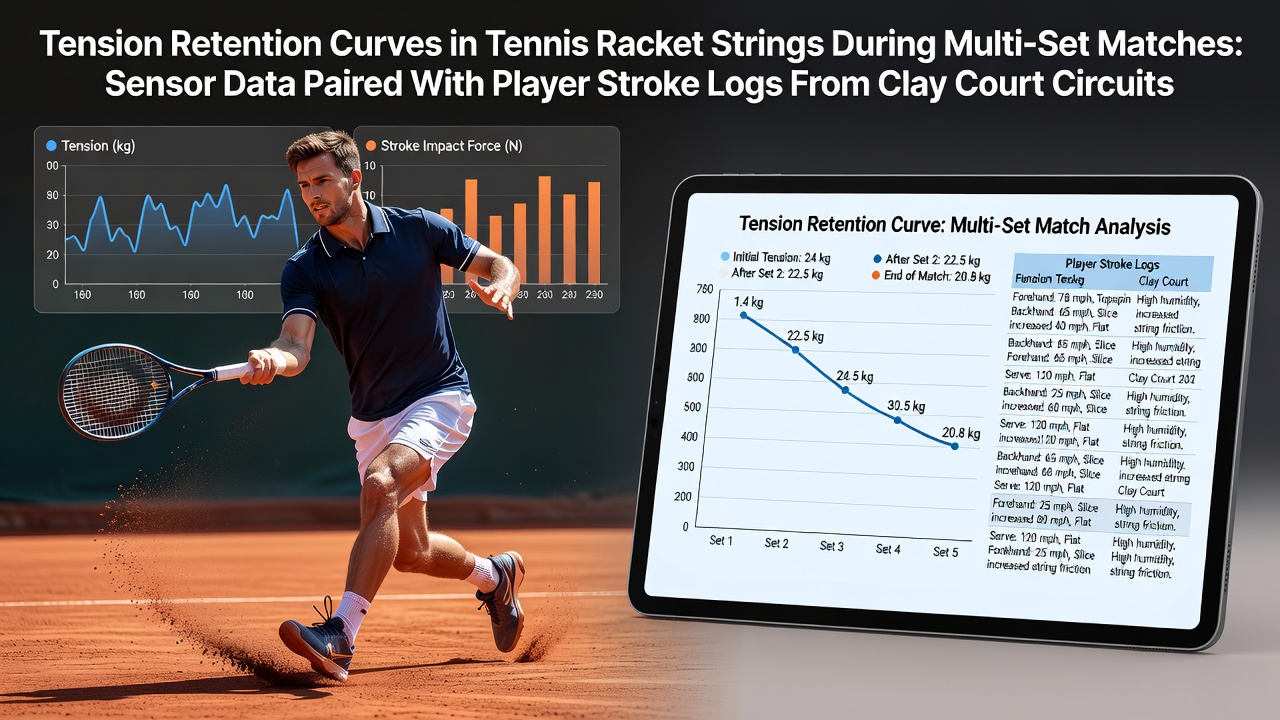
Professional tennis on clay surfaces demands extended rallies that place sustained loads on racket strings, and recent data collection efforts have paired embedded tension sensors with detailed stroke logs from multiple tournaments in the European clay court swing. Observers note that these setups capture real-time tension drops while players log forehand topspin counts, backhand slice frequency, and serve patterns across three-set and five-set encounters.
Studies conducted through the 2026 season show tension loss follows distinct curves rather than linear declines, with the steepest drops occurring in the first set when new strings encounter initial impact forces. Data from clay court circuits indicates average losses of 8 to 12 percent after the opening set, followed by slower stabilization phases where additional sets add only 3 to 5 percent further reduction. Researchers paired these readings with stroke logs to reveal that heavy topspin forehands accelerate early tension decay more than flat shots because the angled contact increases frictional heat and string movement within the frame.
Sensor Integration and Data Collection Methods
Equipment manufacturers and independent labs have deployed miniature load cells attached to main and cross strings on player rackets, transmitting measurements at 10 hertz intervals during matches. These devices work alongside wearable stroke trackers that record swing speed, impact location, and spin rates, allowing analysts to correlate specific shot types with tension changes. In August 2026 tournaments held on red clay, teams collected over 200 match datasets from players ranked inside the top 150, creating a comprehensive map of how string beds respond under prolonged play.
One analysis of these records found that serves contribute disproportionately to tension loss in the upper string bed area, while baseline rallies distribute wear more evenly. Clay court conditions add another variable because the slower surface extends point duration and increases total ball strikes per set compared with faster hard courts, a pattern confirmed across multiple event logs.
Observed Tension Retention Patterns
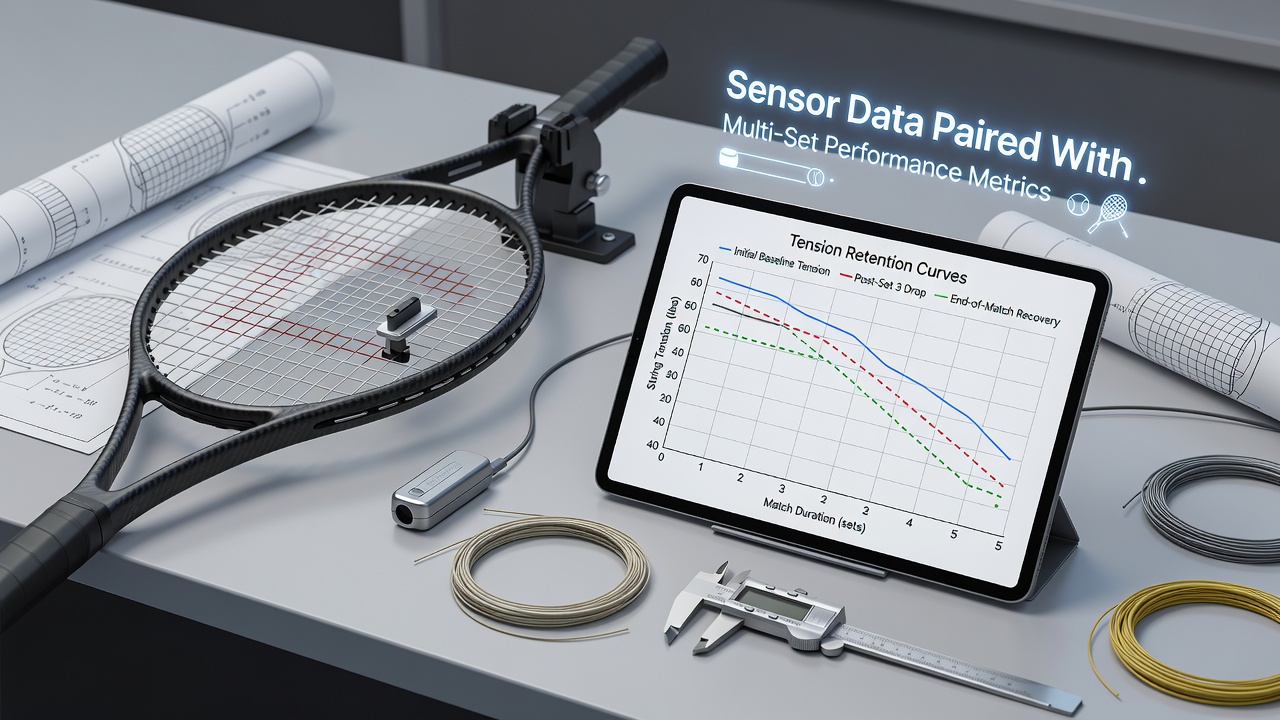
Tension retention curves typically display an initial rapid decline followed by a plateau, yet individual player profiles vary based on string material and tensioning choices. Polyester strings lose tension faster than natural gut hybrids in the early stages, according to paired sensor and log entries, while hybrid setups maintain more consistent levels through later sets. Stroke logs reveal that players who generate higher average spin rates experience steeper initial drops, since greater ball rotation amplifies string-to-string friction during contact.
Further examination of five-set matches shows cumulative tension loss reaching 18 to 22 percent by the final set in many cases, with the rate of change slowing after the third set. These patterns hold across different racket models when researchers control for string gauge and pre-match tension settings, indicating that match duration and shot volume exert stronger influence than equipment variations alone.
Factors Influencing String Behavior on Clay
Clay court play introduces unique environmental factors that affect string performance, including higher humidity levels and fine particle infiltration that can alter string movement within the frame. Sensor data paired with court condition notes from the 2026 circuit demonstrates that moisture absorption slightly increases string elasticity early in matches before drying effects reverse the trend. Stroke logs indicate that defensive sliding shots common on clay generate lateral forces that contribute to gradual bed loosening beyond direct impact damage.
Those who reviewed the combined datasets observed that players adjusting string tension between sets based on real-time sensor feedback maintained more predictable performance curves than those using fixed setups. The integration of stroke volume data further highlights how service games produce sharper tension spikes compared with return games because of higher impact velocities.
Practical Applications for Players and Coaches
Coaching staffs now reference these tension curves when planning string changes during tournaments, using historical match logs to predict when performance degradation might affect shot consistency. Equipment suppliers have incorporated similar sensor technology into testing protocols to refine string compounds for clay-specific durability. The International Tennis Federation maintains public resources on racket equipment standards that align with these measurement approaches, while additional findings appear in reports from the Tennis Australia research division examining surface-specific string demands.
Player stroke logs also reveal correlations between tension loss and error rates in later sets, prompting some teams to experiment with mid-match restringing at predetermined tension thresholds. Such practices draw from aggregated data rather than individual preference, creating more systematic preparation routines across the clay court calendar.
Conclusion
Combined sensor readings and stroke documentation from clay court circuits provide a detailed view of how tennis strings behave across extended matches, revealing predictable tension retention curves shaped by shot type, duration, and surface conditions. These objective measurements continue to inform equipment selection and match strategy without relying on subjective feel alone, and ongoing data collection through 2026 and beyond promises further refinement of these models.