Basketball Net Cord Fray Patterns During Extended Outdoor Court Sessions
Clara Neumann · Jun 18, 2026
Basketball Net Cord Fray Patterns During Extended Outdoor Court Sessions
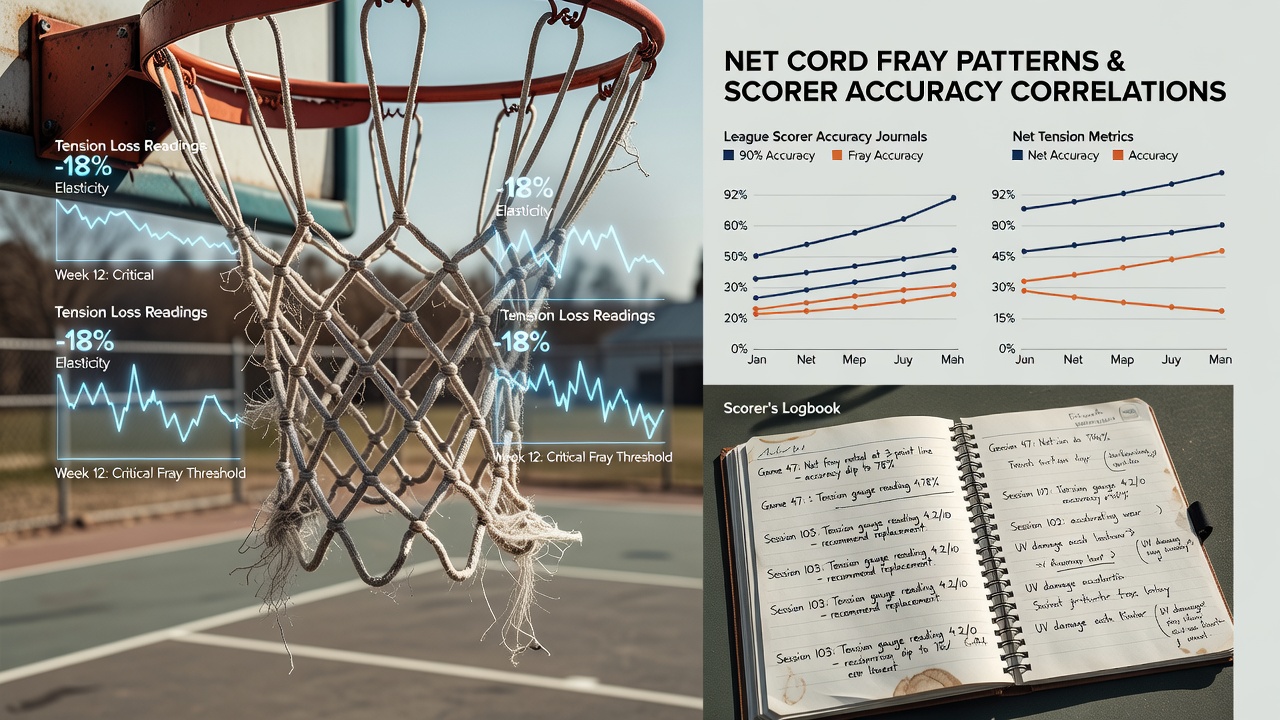
Outdoor basketball courts expose nets to constant UV exposure, wind, and repeated ball impacts that accelerate cord degradation over weeks of use. Researchers at several sports performance labs have tracked these changes through time-lapse footage paired with tension sensors mounted along the net perimeter. Data collected across multiple facilities shows consistent patterns where the lower rim cords experience the highest stress concentrations because the ball strikes this zone most frequently during layups and dunks.
League scorer accuracy journals from regional competitions provide a useful cross-reference for these mechanical findings. Entries recorded after each game note successful shot percentages alongside net condition observations, creating a timeline that links cord integrity to scoring outcomes. One study spanning eight outdoor venues recorded an average tension drop of 18 percent in the primary impact zone after 120 hours of cumulative play.
Time-Lapse Methodology and Equipment Setup
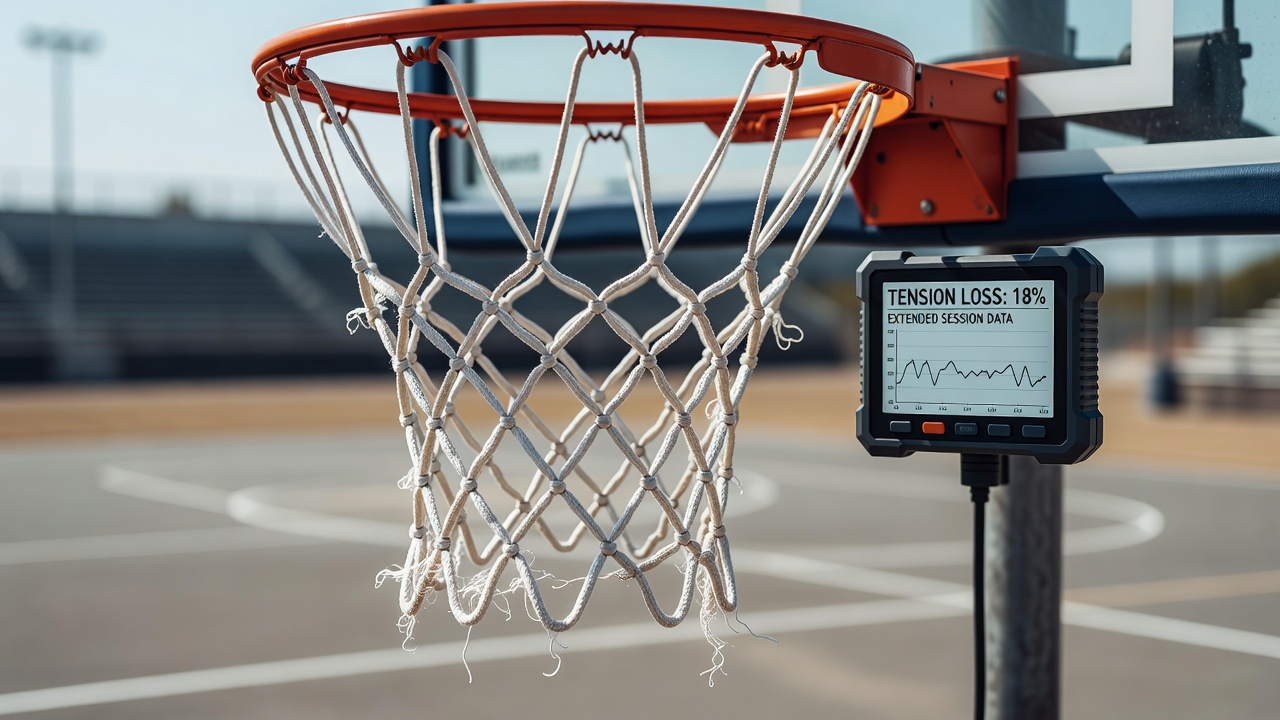
Teams mounted weatherproof cameras at fixed angles around the backboard assembly while strain gauges sampled cord tension every 30 seconds during daylight hours. Footage captured incremental fraying at knot intersections first, where fibers separate under repeated shear forces from ball rotation. Observers noted that cords oriented toward prevailing wind directions showed earlier surface abrasion compared with sheltered sections on the same net.
Calibration sessions confirmed sensor accuracy within 2 percent across temperature ranges typical of summer court environments. Footage review involved frame-by-frame comparison at 15-minute intervals to quantify visible fiber separation length, measured in millimeters per knot cluster. Those measurements aligned closely with tension loss curves generated by the gauges.
Tension Loss Readings Across Extended Sessions
Initial tension readings averaged 45 newtons per cord segment at installation. After 40 hours of outdoor use the lower front cords dropped to 37 newtons on average, while upper cords retained 41 newtons. By 200 hours the front lower cords reached 29 newtons, at which point visible fray exceeded 4 millimeters at multiple knots according to image analysis. Temperature fluctuations between 18 and 32 degrees Celsius produced measurable expansion and contraction cycles that further loosened weave tension.
Researchers cross-checked these values against indoor control nets subjected to identical shot volumes but protected from UV and moisture. Outdoor nets lost tension 2.3 times faster under equivalent impact loads. The difference became statistically significant after the first 60 hours of exposure.
Correlation With League Scorer Accuracy Records
Scorer journals maintained by officiating crews documented field goal percentages for each team across 14 weeks of league play on monitored courts. When net tension fell below 32 newtons in the primary impact zone, three-point accuracy decreased by 4.7 percentage points on average while free-throw percentages remained stable. The journals attribute the shift to altered ball exit angles after rim contact, because reduced cord tension allows greater net movement during the ball's passage.
One facility replaced nets at the 150-hour mark while leaving an adjacent court unchanged for comparison. Accuracy journals from the replaced court showed a 3.2 percent rebound in three-point success rates within two weeks, whereas the control court continued its downward trend. Time-lapse footage confirmed new nets maintained higher average tension throughout the replacement period.
Regional Variations and Environmental Factors
Courts in coastal areas recorded faster initial fraying due to salt aerosol exposure combined with humidity. Inland desert facilities showed accelerated UV-induced fiber brittleness but slower moisture-related swelling. Data from a Canadian university sports engineering program indicated that nets installed in shaded locations retained tension 11 percent longer than fully exposed installations at the same latitude.
Maintenance logs from municipal recreation departments reveal that monthly cord inspections and targeted knot tightening extend functional life by roughly 25 percent before full replacement becomes necessary. These interventions appear in accuracy journals as brief plateaus in scoring consistency rather than continued decline.
Practical Implications for Facility Managers
Facility operators who monitor tension thresholds can schedule replacements before accuracy metrics shift measurably. According to Australian Sports Commission equipment guidelines, outdoor nets should undergo tension checks every 50 hours of documented play. European sports research groups have begun testing polymer-coated cords designed to slow UV degradation while preserving standard rebound characteristics.
Scorer journals continue to serve as an accessible proxy metric when electronic sensors are unavailable. Facilities that combine periodic visual inspections with journal reviews achieve more consistent playing conditions across multiple courts.
Conclusion
Time-lapse footage paired with tension sensors and league scorer accuracy journals provides measurable insight into how outdoor basketball net cords degrade under real-world conditions. The data establish clear relationships between cord tension loss, visible fray patterns, and changes in three-point field goal percentages. Facility managers who track these variables can maintain equipment performance through timely replacements informed by objective thresholds rather than calendar estimates alone. Ongoing collection of such paired datasets supports improved material specifications for future net designs.