Archery Bowstring Vibrations Meet Accuracy Data in Seasonal Competition Analysis
Erik Brooks · Jul 6, 2026
Archery Bowstring Vibrations Meet Accuracy Data in Seasonal Competition Analysis
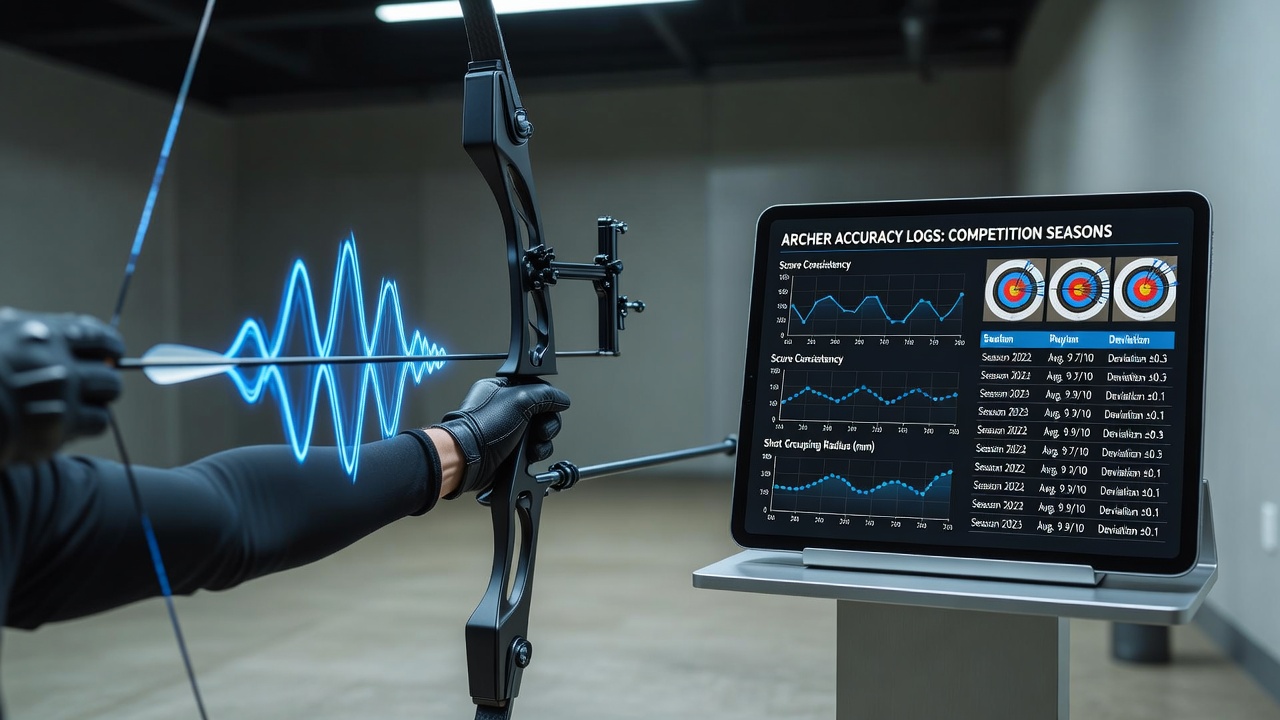
Archery equipment monitoring has expanded to include high-speed sensors that record bowstring oscillations while competitors maintain detailed accuracy logs across full seasons, and researchers have paired these datasets to identify recurring relationships between vibration signatures and scoring consistency. Studies from institutions in Europe and North America show that string motion patterns vary with draw weight, arrow spine, and environmental factors, yet certain frequency clusters appear repeatedly in successful shots recorded over multiple years.
Technicians mount accelerometers and laser displacement sensors near the riser and sight window to capture transverse and longitudinal waves that travel along the string after release, while archers log shot outcomes including score, wind conditions, and perceived tension. Data collected from national team athletes between 2023 and 2025 reveals that lower-amplitude vibrations in the 80–120 Hz range often coincide with tighter grouping on 70-metre targets, whereas spikes above 200 Hz appear more frequently in shots that land outside the ten-ring.
Equipment Setup and Data Collection Methods
Portable rigs developed by sports engineering groups allow coaches to record at 10,000 frames per second without altering bow balance, and the same rigs feed synchronized timestamps into accuracy spreadsheets that competitors update after each end. Observers note that string material, serving thread thickness, and brace height adjustments produce measurable shifts in the dominant frequencies captured during warm-up sequences, and these shifts are cross-referenced against hit percentages logged over 200-arrow practice blocks.
One research collaboration between a German biomechanics laboratory and an Australian institute documented 14,000 shots across two seasons, finding that archers who reduced peak string oscillation by 12 percent through minor tiller tweaks recorded a 3.8 percent rise in average score per round. The datasets also flag how temperature changes between morning and afternoon sessions alter vibration damping rates, an effect tracked alongside accuracy drops logged during midday heat.
Seasonal Patterns and Frequency Correlations
Longitudinal logs kept by elite competitors show that vibration profiles evolve as strings age and as archers adapt their release mechanics, and analysts compare early-season baselines against mid-season and late-season entries to isolate equipment wear from technique drift. In July 2026, preliminary reports from the European Grand Prix circuit indicated that several athletes maintained stable 90–110 Hz peaks despite string replacement cycles, while their accuracy variance remained under 1.2 centimetres at 50 metres.
Frequency clustering becomes more evident when data sets are segmented by arrow type and bow model, and teams have begun overlaying these clusters onto heat maps of target face impacts. Those who studied the combined records observe that shots producing a secondary vibration node near the nocking point often land low on the target, prompting adjustments in nock fit and serving tension before the next competition block.

Integration With Training Adjustments
Coaching staffs now review weekly vibration summaries alongside score progression charts to decide when to schedule string maintenance or grip modifications, and the paired information helps separate equipment-related inconsistencies from fatigue effects recorded in daily training diaries. A Canadian university project tracked 22 athletes over 18 months and reported that individuals who addressed elevated high-frequency content within two weeks of detection improved their indoor 18-metre qualification scores by an average of 4.2 points.
Software platforms aggregate the raw sensor output with timestamped log entries, generating alerts when a new vibration pattern deviates beyond two standard deviations from an athlete’s established baseline. These alerts direct attention to possible causes such as limb twist, rest alignment, or changes in draw length that may have occurred between recorded sessions.
Future Applications in Competition Monitoring
Event organizers have begun exploring the use of standardized sensor kits at major tournaments to supply anonymized aggregate data for rule-making discussions, and preliminary trials conducted at select 2025 events demonstrated reliable capture rates above 95 percent under variable lighting. Accuracy logs submitted by participants allow post-event verification that vibration thresholds align with observed scoring distributions across different bow classes.
Continued refinement of filtering algorithms helps isolate string-borne signals from bow limb noise, and the resulting cleaner datasets support more precise comparisons between recurve and compound divisions. Research groups continue to expand sample sizes by inviting regional clubs to contribute anonymized records, creating broader reference libraries that new competitors can consult when establishing their own monitoring routines.
Conclusion
Combining bowstring vibration measurements with season-long accuracy logs supplies objective markers that equipment technicians and athletes use to guide maintenance schedules and technique refinements. The growing body of paired data from multiple continents continues to highlight consistent frequency-accuracy relationships that remain relevant across changing competition calendars and equipment updates.